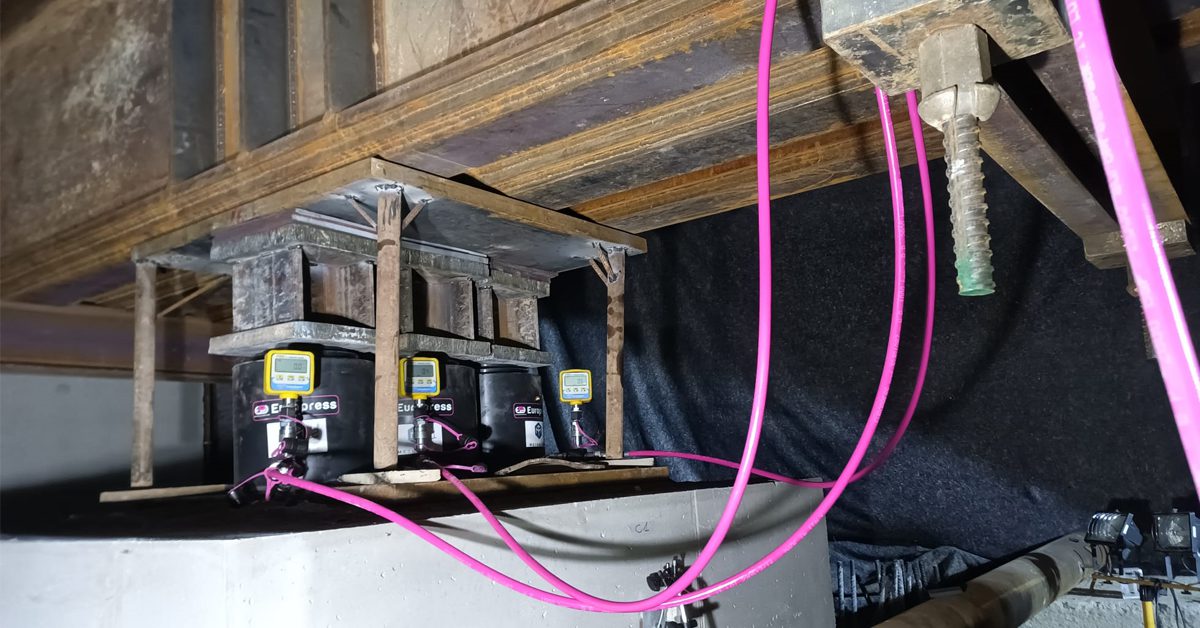
The vertical pile load test (static load test) is used to determine the bearing capacity and deformation behavior of a foundation pile in situ. It is considered the most reliable method to validate project design assumptions.
The test is performed on a pile identical to those used in the project. The pile is either left protruding from the ground or connected to a concrete test head, and a high-pressure hydraulic cylinder is placed on top. The piston of the cylinder pushes against a reaction system: either steel beams connected to reaction piles, or a reaction frame resting on the ground. The cylinder applies increasing loads to the pile. After each increment, the settlement is recorded, and the load is maintained for a predetermined time until the settlement stabilizes. At the end of the test, the pile is gradually unloaded and the elastic rebound is measured.
The test provides the pile load–settlement curve: in the first part, the response is nearly elastic (with limited settlements), followed by more pronounced plastic deformations until the ultimate capacity of the pile is reached (rapid settlements).