


Scheldt Tunnel in Antwerp
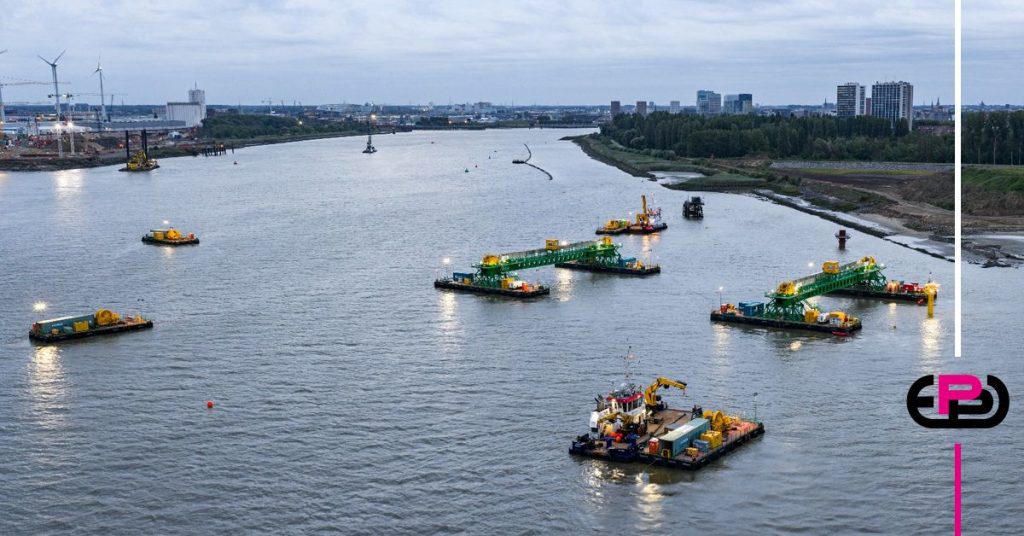
Europress supplied the hydraulic cylinders used by Molhoek Infratechniek B.V. during the realization of the Scheldt Tunnel, a key infrastructure project within the Oosterweel Link in Antwerp. Working on behalf of IMMONTEC, Molhoek supported the immersion and positioning of the tunnel elements with a highly specialized hydraulic setup. Eight tunnel elements were built near Zeebrugge and transported 123 km to the north of Antwerp, where they are being immersed and assembled into a traffic tunnel. After immersion, each element must be moved into the correct position, with the operation precisely monitored using GPS. For positioning, Molhoek uses various jacking systems. Pulling cylinders mounted on the roof of the tunnel compress the rubber Gina profile to seal the immersion joint between two elements. Inside the element, jack pins rest on a so-called tile in the immersion trench to adjust height and roll on the secondary side. Together with the primary supports, the jacking forces are monitored during the flooding of the elements. Horizontal alignment is achieved through a wagging system installed in the joint between the elements at the outer wall. On each side of the tunnel, a tower of ten double-acting 700 bar high-pressure cylinders, each with a capacity of 300 tonnes and a stroke of 300 mm, provides a total pushing force of 6,000 tonnes. For this application, the hydraulic cylinders were equipped with additional seals to prevent seawater ingress during operations at depths of up to 50 metres underwater. Europress’s standard internal and external Nitreg ONC surface treatment ensures excellent corrosion protection, making the jacks suitable for harsh marine environments. The cylinder towers are installed by divers on the tunnel wall and connected to hydraulic hose sets routed through flange penetrations in the bulkhead into the tunnel, where they are connected to hydraulic power units. After flooding and securing the position, the cylinders are retracted, dismantled and moved to the next tunnel element. This final stage of the positioning process is carried out entirely underwater and out of sight. Thanks to HyPower.nl and Guido van Rhee
Record-breaking times on a motorway construction site

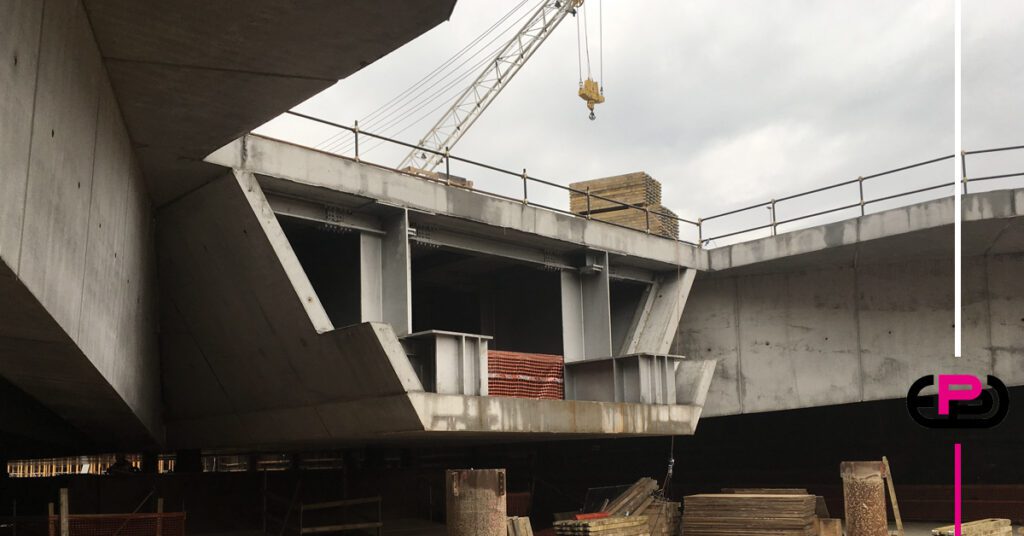
The Europress COF series hollow cylinders with integrated counterbalance valve played a key role in the construction of this dual carriageway bridge by enabling the safe positioning of special lattice girders. Due to the unstable ground conditions in the central span, a traditional stationary support was not a viable option. Thanks to these hydraulic tools, the construction time for both load-bearing structures was reduced to just 70 days. Reliability, expertise, and technical support: when these elements make the difference, Europress cylinders are the right solution. Whether it’s a complex application or a specific requirement, having a partner that provides both high-quality products and professional support is essential. With Europress, you’re not just buying a cylinder: you’re choosing tailored, fast, and effective technical assistance.
Our technology for an arch bridge
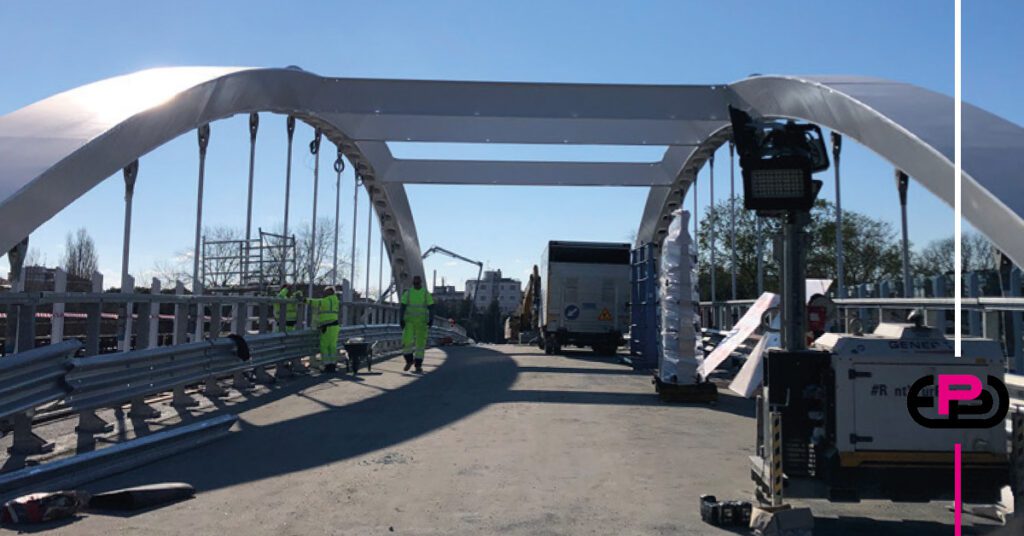
During the strengthening of the new Teodorico Railway Overpass in Ravenna, CMF hollow cylinders and high‑pressure PN pumps were used to install and tension the tie rods connecting the deck to the arches. An efficient solution offering significant technical benefits: precise alignment of tie rods and strands; reduced invasiveness of drilling and anchorage systems; constant monitoring of tensioning parameters; guarantee of long‑term durability and reliability This project is a significant example of how specialized technologies can be applied in arch bridge strengthening, ensuring the long‑term functionality and safety of load‑bearing structures.
Stabilizing offshore wind towers: the challenge of installation in the marine environment
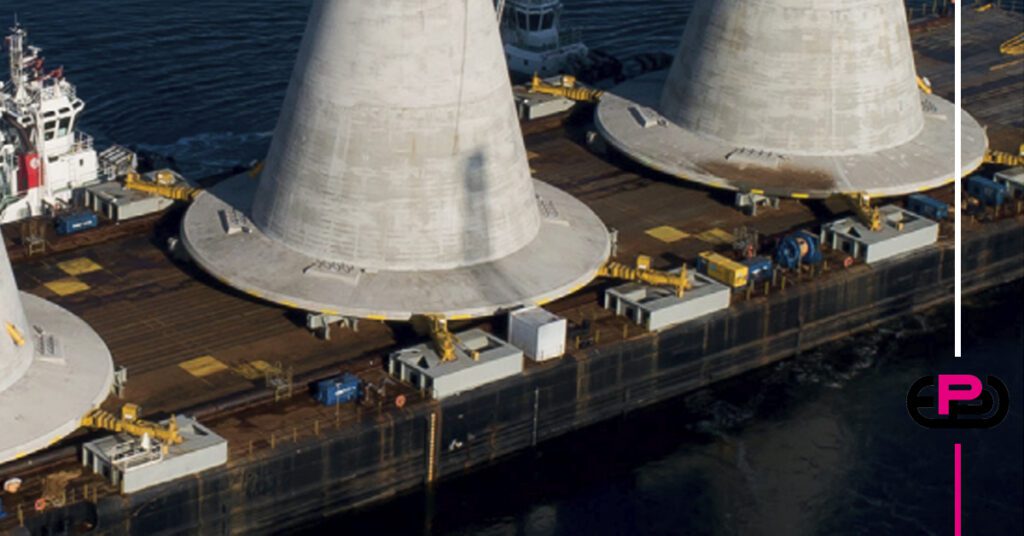
Wind energy is one of the most promising solutions for the energy transition, but installing wind towers in open seas presents unique engineering challenges. Waves, currents, and wind exert immense forces on structures, making the stabilization of the foundation during installation crucial. Thanks to high-pressure hydraulic cylinders and special control units, Europress provides advanced systems for leveling and securing during the transportation of offshore wind towers. Our systems allow for: – Lifting and precisely positioning the wind tower base. – Compensating for misalignments to ensure secure anchoring. – Operating in hostile marine environments, thanks to materials treated against corrosion such as Nitreg Onc and special certified coatings for marine use.
Reno bell tower
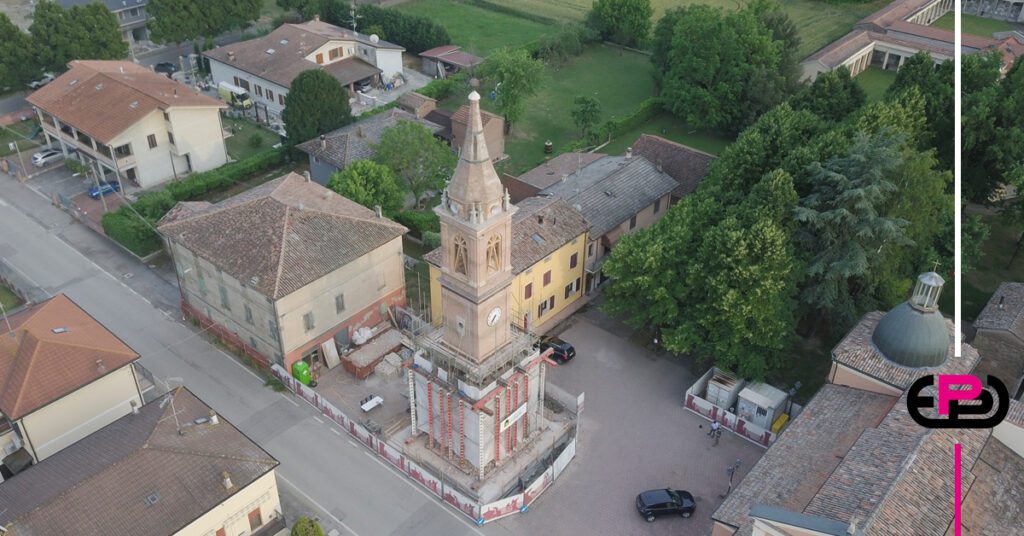
Repositioning Reno bell tower The heart quake occurred in May 2021 damaged severely the church of Reno Centese, in particular it generated a crack which caused the shifting and the rotation of the bell tower starting from 8 meters up to the top of the bell tower itself. In May 2021 the reorganization and repositioning operations were carried out which provided for the safety of the structure with the construction of a basement and support piles, on which four steel beams which had the task of supporting the shaft of the ball tower once separated from the base, by diamond wire cutting. Euro Press Pack contributed to this spectacular and fragile intervention with its hydraulic equipment, in particular the CGG cylinder series with its mechanical ring nut which lifted and maintained in position the shaft of the ball tower after the cut and the CMF hollow ram cylinder series which rotated and translated the bell tower in its original position.
New high speed station in Florence
Florence, Italia After various stops, the last one in 2016 and the collapse of the Nodavia consortium, the works for the construction of the new high speed station in Florence have taken off under the direct guidance of RFI. For the start of the job all the Tav operations have been assigned to a new company entirely owned by RFI called Infrarail srl. The company was born in September 2019 with the goal to develop the project of the high speed route of the Florence intersection and to build the new Av Florence Belfiore railway station. Sector: Infrastructures and Structural Interventions Location: AV Florence Belfiore railway station Intervention: Positioning of the roof insole of the new high speed railway station in Florence Hydraulic equipment employed: CGG cylinders with ring nut and ME modular power packs
Railway overpass RFI – Ravenna

Sector: Infrastructure and Structural interventions Location: Ravenna Intervention: Pulling Rods tensioning for the new “Teodorico” Bridge Hydraulic equipment utilized: CMF hollow piston cylinder and PN double stage hand pumps March 2021- Ravenna. A new railway overpass has been built by “Rete Ferroviaria Italiana” (Italian FS Group), in substitution of the old “Teodorico” bridge. The dimensions of the old bridge didn’t allow the passage of cargo trains which transported semi-trailers or big lorries. For its construction have been employed 440 tons of steel, shaped and cut with more than 6 thousand hours of work. It has a length of 58 meters, a wideness of 19 meters and it goes over the railway at a height of 7 meters. The work is isostatically constrained at the ends by support devices and its suspended vertically from the steel arches by 13 Pulling Rods on each side with a diameter of 80 mm placed at intervals of 3.52m. The metallic structure, assembled inside the building site, has been launched at the end of December 2020. The “skeleton” of the new bridge has been initially lifted by the means of hydraulic cylinders and then placed on special lowered trolleys, finally the correct tensioning of the pulling rods was carried out. EuroPressPack supplied the hydraulic cylinders and hand pumps which have been used for the initial positioning of the deck and for the tensioning of the tie-rods which fasten the deck to the arches. 2 hollow 30 ton piston cylinder each, were able to allow the delicate operation of tensioning the Mcalloy bars. The cylinders have been mounted in parallel and they connected through the tie-rods two vises which tightened the two extremities which needed to be drawn near.
The new Polcevera viaduct
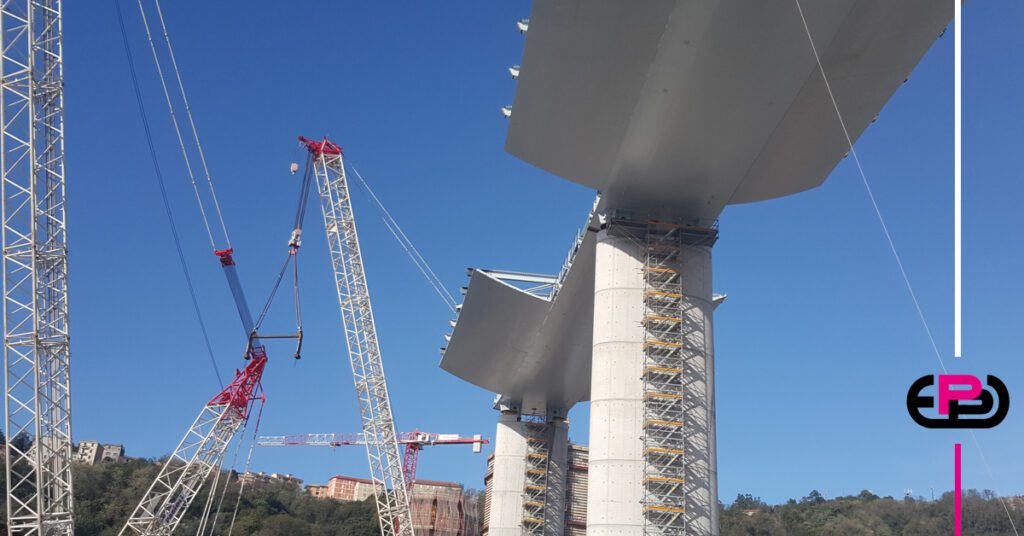
The importance of details EUROPRESS PRESS PACK A COMPANY FROM LIGURIA SUPPLIED THE HYDRAULIC POWER PACKS AND HIGH TONNAGE CYLINDERS FOR THE LIFTING AND MOUTING OPERATIONS OF THE NEW POLCEVERA VIADUCT During the reconstruction work on the new Genoe- se Polcevera viaduct, a lot of small to medium-sized companies as well as large compa- nies have taken part in this project. Among the former the company Euro Press Pack Spa particularly stands out. This company is an Italian leader in the construction of high to very high pressure, traction and lifting hydrau- lic components and it was involved in the project from the very start. It ini- tially supplied the Vernazza Autogru company with equipment used du- ring the clearing and safety procedu- res following the collapse of the brid- ge. Then the Fincantieri infrastructure company who built the metallic fra- meworks, chose Euro Press Pack to supply the equipment necessary for the lifting and mounting operations of the new bridge. In fact, numerous hydraulic power packs and about one hundred high tonnage cylinders (100, 300 and 500 tonnes) supplied betwe- en September 2019 and February 2020, have been used in all the opera- tions related to the positioning of the bridge deck, the regulating and abo- ve all the lowering to the definitive level established by the project. The launch of the viaduct was cha- racterised by two macro phases: the first which went from October 2019 to mid-May 2020 focused on the lifting operations during which the EPP cylinders played a fundamental role by supporting the positioning of the single bays on the structure. Howe- ver, it was during the second phase that the EPP cylinders became the hidden protagonists during the ma- noeuvring. In fact from mid-May the structure weighing 17,000 tonnes, was positioned at a higher level than established by the project in order to allow a series of operations during the assembly and was then lowered by 265 millimetres to be definitively positioned on the bases which con- nect the structure to the pillars be- low. During these manoeuvres the EPP cylinders (see picture) were en- capsulated in their metallic structures which allowed for the correct appli- cation of the necessary force to ma- noeuvre the structure in total safety. These operations required the use of more than 70 cylinders and their re- lative high-pressure working systems which were positioned on each stack and shoulder of the viaduct. Euro Press Pack has also been an impor- tant supplier to Spic Srl company which between January and March 2020 purchased different types of cylinders such as gravity return and spring return, hand-powered pumps and electric power packs to carry out the regulation of the carpentry ele- ments during the pre-assembly pha- ses of Bays SPA P1 and P9 – P10. Euro Pass Pack proved its worth in July 2019 when it supplied a Geno- ese company of excellence, Vernaz- za Autogru in record time with hy- draulic sets with high tonnage and stroke cylinders to accompany their cranes and ballasts during weight tests requested by the Ministry of Infrastructures and Transport. This was carried out with the support of six Universities and various research bodies who used the collapse of the Alveo Vecchio Viaduct on the A16 motorway as a case study. This brid- ge, which was built in the sixties and no longer utilized, was submitted to weight tests bringing it to the point of collapse in order to study its tech- nical resistance and refine in the best way possible the techniques guaran- teeing infrastructure safety. The Minister of Infrastructure and Transport through the Territorial In- spection Office (UIT) in Rome and led by Engineer Placido Migliorino, with the help of Professors from the Universities of Trento, La Sapienza in Rome, Federico II Naples, the Polyte- chnic in Turin and the University of Chieti used these tests to compile ahandbook for motorway companies with clear and precise guidelines on the criteria to use when evaluating the safety of viaducts. The tests car- ried out on the A16 motorway have been used to verify the practices which motorway companies should adopt in order to monitor the state of health of infrastructures. The tests carried out on the Alveo Vec- chio viaduct, which are of great scien- tific interest and unique in this field, have meant that the actual behaviour of viaducts in critical situations du- ring use and collapse can be studied. Besides, important information can be gathered on safety standards, with particular reference to the investiga- tions into the measures which go- vern the resistance and durability of structures and can then be added to motorway company guidelines.
New coastal road viaduct

France, 2017-2019 GENERAL DESCRIPTION Designed to keep cars away from the risk of cliff rock falls and to withstand cyclonic swells, this sea viaduct runs along the coast for 5.4 kilometres between the north and west of Reunion Island. Parallel to the coast, this bridge over the water is made up of seven successive decks of 769 metres each. An exceptional structure in terms of its characteristics and its maritime location, it is also exceptional in terms of the diversity of the tools and methods used to build it. 95% of the elements of the bridge were prefabricated on land in two prefabrication plants and then installed by sea or by launcher. For offshore operations, a single mega barge was specially equipped for coastal navigation in difficult seas. It was fitted with two overhead cranes and a concrete plant, Zourite mobilised a team of experienced sailors to transport and place on the seabed the elements of the 48 piles of what is now the longest viaduct in French sea waters. The pillars are composed by two parts, an upside down mushroom-like base and an upper part destined to support the spans, which is installed later. The sea bottom, on which the end of the pillars are placed, even if it has been prepared and leveled may result not perfectly flat and some protrusions can occur. For this reason also the connection with the upper part can be compromised. This is where our cylinders come into play, they are positioned in special support points on the superior part of the foot to allow to place vertically, and at the correct level, the upper part of the pillar. More specifically, there are 4 couples of single stage-ring nut spring return cylinders with tilt saddle, with a capacity of 900tons and a stroke of 150mm each. Each couple can be operated independently by an electronic device which, depending on the final position to be reached, acts the cylinders by following an isostatic scheme where the two couples are hydraulically connected to work in parallel and the other two couples constitute the two final points. The system allows the synchronous lifting and lowering until a common height is reached corresponding to the cylinder, (or a group of cylinders) lower for the lifting or higher for the lowering. Starting from this position the other groups of cylinders are brought to the final position. With the lock ring nuts brought to flush the cylinders have the goal to support the upper parts while the concrete is being poured, once the concrete becomes solid they are removed and ready to be used on the following pillar.
ITER 2019

ITER ( International Thermonuclear Experimental Reactor) France, San Paul Les Durance – Year 2019 With the help of numerous EUROPRESS cylinders and power packs, a lot of shifting and positioning operations have been carried out on the Tokamak, the beating heart of the reactor.