


Scheldt Tunnel in Antwerp
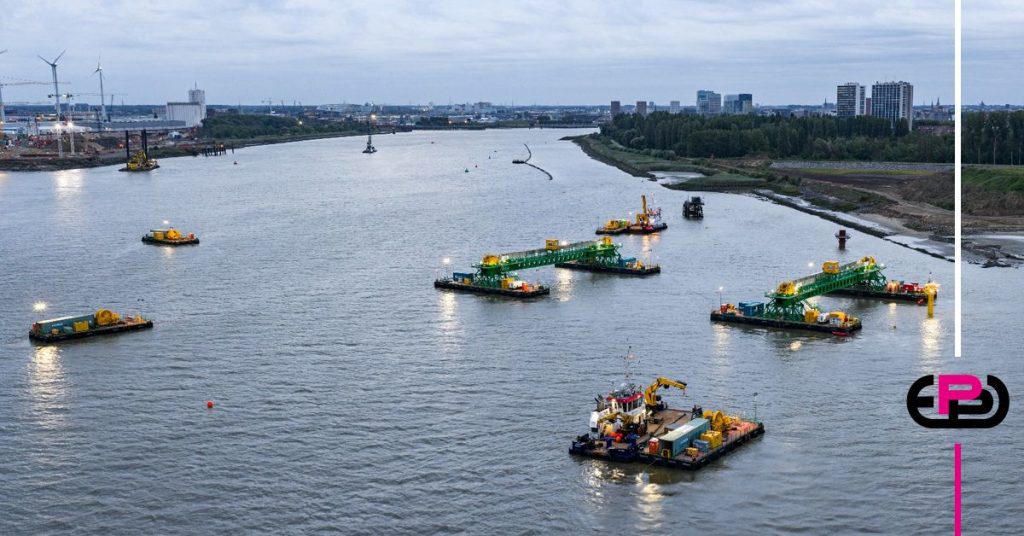
Europress supplied the hydraulic cylinders used by Molhoek Infratechniek B.V. during the realization of the Scheldt Tunnel, a key infrastructure project within the Oosterweel Link in Antwerp. Working on behalf of IMMONTEC, Molhoek supported the immersion and positioning of the tunnel elements with a highly specialized hydraulic setup. Eight tunnel elements were built near Zeebrugge and transported 123 km to the north of Antwerp, where they are being immersed and assembled into a traffic tunnel. After immersion, each element must be moved into the correct position, with the operation precisely monitored using GPS. For positioning, Molhoek uses various jacking systems. Pulling cylinders mounted on the roof of the tunnel compress the rubber Gina profile to seal the immersion joint between two elements. Inside the element, jack pins rest on a so-called tile in the immersion trench to adjust height and roll on the secondary side. Together with the primary supports, the jacking forces are monitored during the flooding of the elements. Horizontal alignment is achieved through a wagging system installed in the joint between the elements at the outer wall. On each side of the tunnel, a tower of ten double-acting 700 bar high-pressure cylinders, each with a capacity of 300 tonnes and a stroke of 300 mm, provides a total pushing force of 6,000 tonnes. For this application, the hydraulic cylinders were equipped with additional seals to prevent seawater ingress during operations at depths of up to 50 metres underwater. Europress’s standard internal and external Nitreg ONC surface treatment ensures excellent corrosion protection, making the jacks suitable for harsh marine environments. The cylinder towers are installed by divers on the tunnel wall and connected to hydraulic hose sets routed through flange penetrations in the bulkhead into the tunnel, where they are connected to hydraulic power units. After flooding and securing the position, the cylinders are retracted, dismantled and moved to the next tunnel element. This final stage of the positioning process is carried out entirely underwater and out of sight. Thanks to HyPower.nl and Guido van Rhee
Hydraulic bolt tensioning
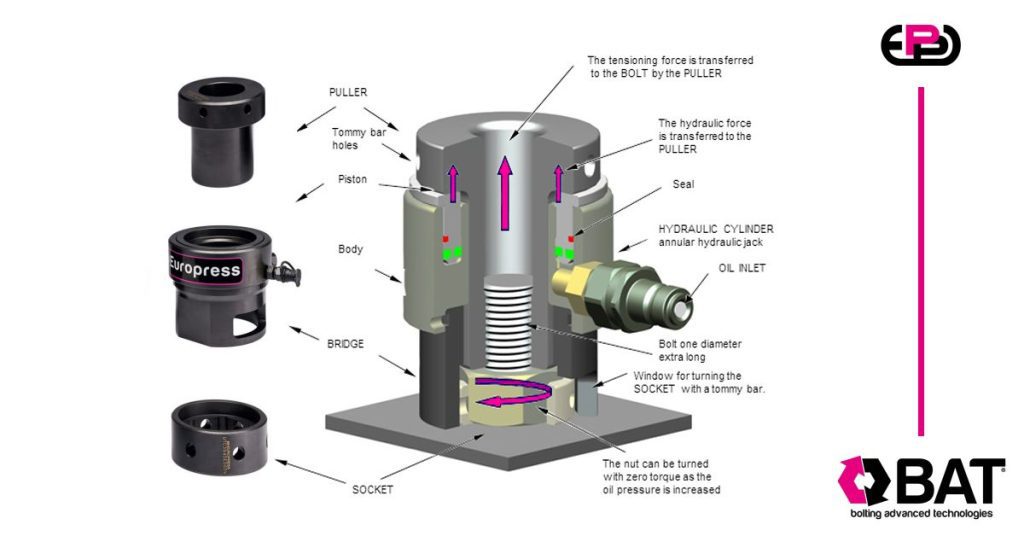
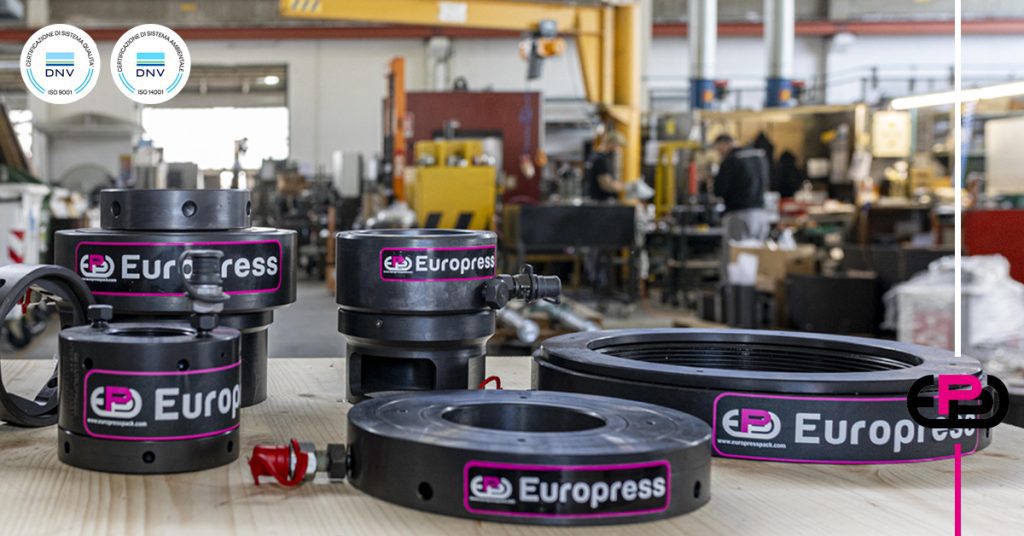
Hydraulic bolt tensioning is a technique used when a highly accurate and uniform preload is required in bolted joints, particularly in flanges or other critical structures.Unlike traditional tightening methods—such as torque wrenches or hydraulic torque tools—which apply a torque to achieve the desired preload, hydraulic tensioning works by applying a direct axial force to the bolt or stud using a high-pressure hydraulic tensioner, typically operating up to 1,500 bar.This method is widely used in industries where reliability and precise load control are essential, such as petrochemical plants, turbines and generators, pipeline flanges, offshore structures, and large heat exchangers.The main advantage of hydraulic tensioning is that the resulting preload depends directly on the applied hydraulic pressure. This eliminates the high level of uncertainty associated with friction—both under the bolt head and in the threads—which affects all torque-controlled tightening methods. Such uncertainty tends to translate almost linearly into variations in the achieved preload.As a result, tightening errors are significantly reduced, and a much more uniform preload can be achieved across all bolts.
Precision Hydraulic Technology in Shipbuilding
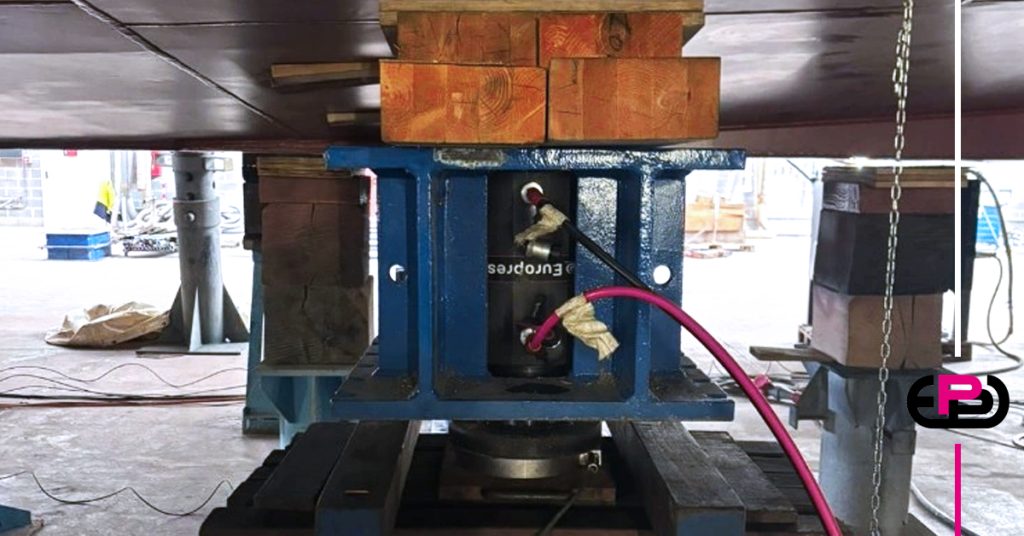
The weight of a hull is measured using hydraulic cylinders pressurized up to 700 bar. The cylinders are positioned at strategic points along the structure and used to lift the hull in a controlled manner, allowing the load at each support point to be measured with high accuracy. By monitoring the hydraulic pressure and knowing the piston surface area, it is possible to calculate the force exerted by each cylinder and thus determine the overall weight of the hull. It is a procedure that requires careful planning, precise pressure control, and a strong focus on safety.
Rock mass stabilization systems
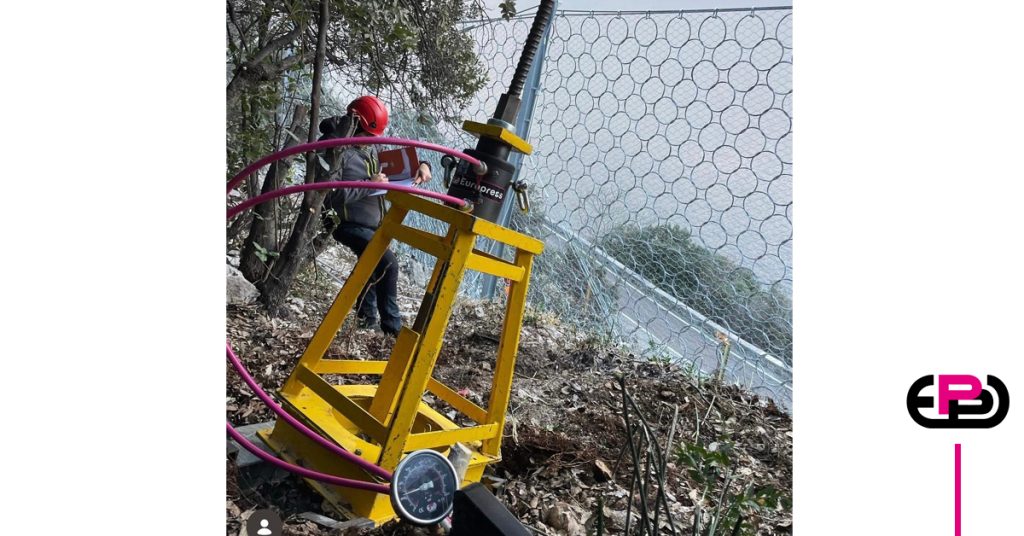
Rockfall protection is not just a mesh on a slope — it is an engineered safety system designed to perform when it truly matters. Every day we drive along mountain roads, walk beneath rocky slopes, relax on beaches, or work in exposed areas without thinking about what might be hanging above us. Rockfall barriers and rock mass stabilization systems play a crucial role in protecting people, infrastructure, and entire territories. Yet there is an aspect that often goes unnoticed. Behind every installation there are highly skilled professionals working in challenging environments, often suspended on steep rock faces, combining technical expertise with focus and courage. And a proper intervention does not end with installation. During testing, pull-out tests are performed on anchors — bars, rock bolts, and tendons — using hydraulic cylinders connected to manual or electric pumps. These tests are not a mere formality. They are essential to confirm that each anchor delivers the load capacity required by design and that its bond to the rock or soil can withstand long-term stresses. They certify that the system has been installed in full compliance with technical specifications and, above all, ensure real, measurable safety — not something assumed on paper, but something verified in the field.
Our engineering department

Behind every one of our products lies the precise, often unseen work of a highly skilled team: our engineering department. Everything starts there, in the small actions of everyday work — discussing a single component to understand geometries, fits and surfaces; a phone call to align application constraints and timelines; an on-screen review of the design and rendering before moving on to production and testing. This is where risks are addressed upstream and real requirements and operating conditions are translated into robust engineering choices. In high-pressure hydraulics, quality is not something added at the end of the process. It is built in from the beginning — through design, verification criteria, process consistency, and the discipline with which every detail is controlled.
Pile load tests

In the field of structural geotechnics, pile load tests are a key tool for verifying the bearing capacity and deformation behavior of foundation piles. In this context, the ME-PP and MM-PP Europress power packs provide advanced and reliable management of static pile load tests, offering: ✔ Automatic control of single or double-acting hydraulic jacks ✔ Automatic pressure reactivation (even in case of structural yielding) ✔ Real-time acquisition of load and displacement data ✔ Compatibility with analog and digital sensors ✔ Intuitive graphical user interface Widely used on both civil and infrastructure construction sites, these power packs have become the technological standard for foundation pile testing.
Europress 2025
We wrapped up the year on a high note. Complex machining processes and high-precision finished cylinders marked the end of the year, reflecting our expertise, technology and attention to detail. As the new year begins, we move forward with fresh energy—open to new challenges and more driven than ever to turn complexity into performance.
Certifications
We are pleased to announce the renewal of our ISO 9001 and ISO 14001 certifications A big thank you to DNV Italy for their valuable work, ensuring and supporting the quality and integrity of the companies they certify. A certification audit which, as always, was thorough and detailed, and concluded with no remarks or non-conformities , we move forward with confidence, ready to embrace new goals and challenges.
Single-strend

Bridges, viaducts, and large buildings rely on a key technology: post-tensioning. After casting, steel strands are tensioned with single-strand hydraulic jacks powered by high-pressure power units, increasing load capacity, minimizing cracking, optimizing materials, and enhancing durability. Single-strand jacks apply high forces with high accuracy; they are used for commissioning bridge stay cables and for localized post-tensioning of slabs and industrial pavements. The anchorage head with a wedge clamp ensures each strand reaches the design tension, securing structural integrity and long-term reliability. Force, precision, reliability: the essentials of safe, long-lasting infrastructure.
Handling of boulders from landslides

We’re proud to stand by our Firefighters, who work in extreme conditions to keep everyone safe. Our high-efficiency hydraulic system supports their rock-moving operations during road restoration, providing power, precision, and reliability in every mission.